

Mind Weather
Learning to stand still while the storm passes.

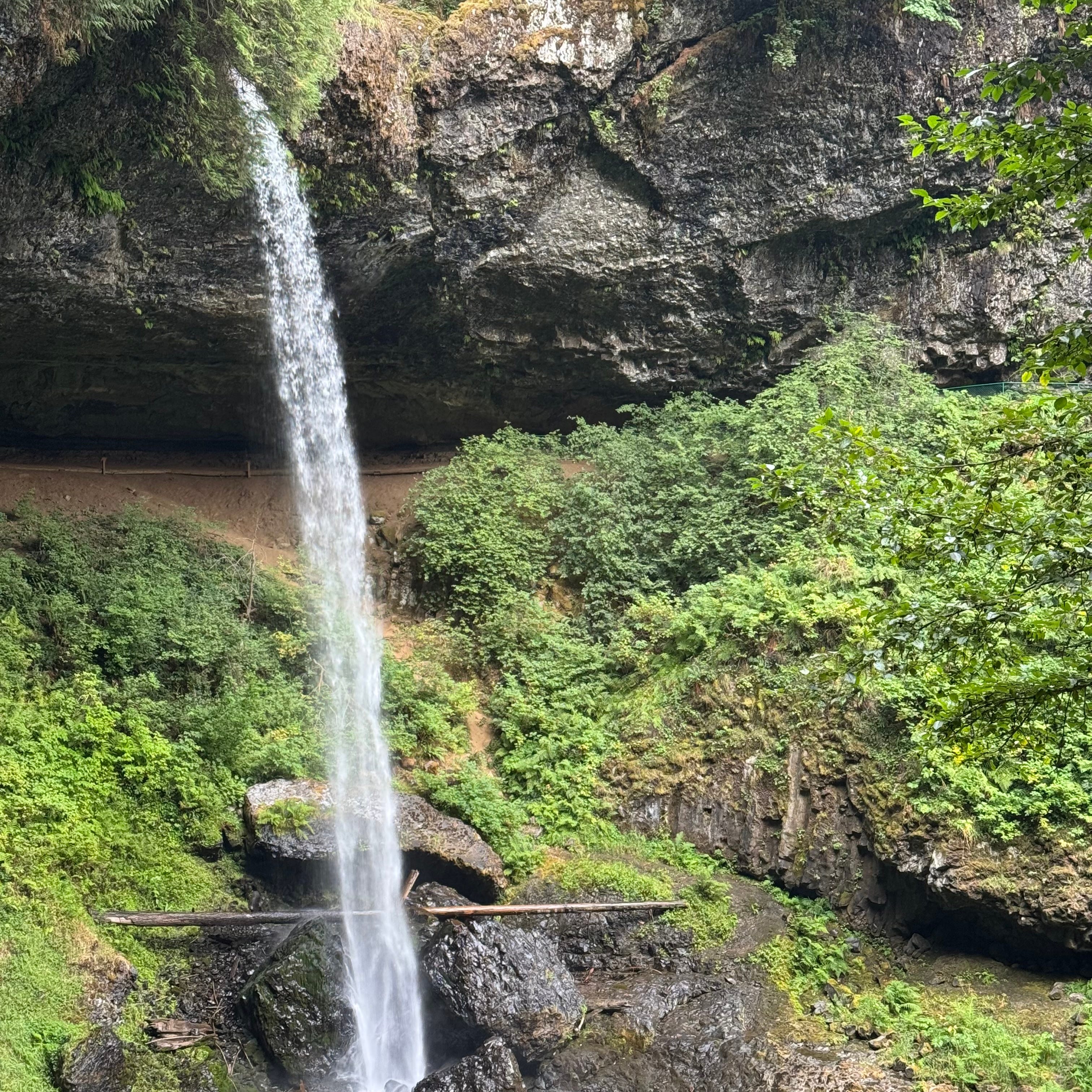
The trail had been climbing for two miles. Switchbacks through Douglas fir and hemlock, roots like twisted veins across the path, moss covering everything that stood still long enough. My lungs burned. My calves screamed. But I kept moving because moving felt better than thinking.
I wasn’t lost. I just didn’t know where the hell I was going.
The sound hit me first—that low roar that means water falling from somewhere high. Then the trail opened up and there it was: fifty feet of whitewater hammering down into a pool so clear you could see the rocks at the bottom, even through the mist.
I stopped. Caught my breath. Let the sound fill the space where my thoughts had been.
A man walked out of the water beneath the falls. Just walked. Like he’d been standing under all that force and decided it was time to leave.
He was maybe sixty, maybe older. Hard to tell with some folks. Shirtless, jean shorts dripping, gray hair plastered to his head. He moved slow, like his joints had been soaked loose. No towel. No gear visible. Just a small pack on the rocks.
He saw me watching. Nodded.
“Water’s cold,” he said, like that explained everything.
“I bet,” I said.
He sat down on a flat rock, let the sun hit his chest. Didn’t seem in a hurry to put his shirt back on or explain why he’d been standing under a waterfall in October.
I sat down too. Close enough to talk if he wanted to. Far enough to not be weird about it.
We sat in silence for a while. Just the falls and the birds and the Douglas fir creaking in the wind.
“Someone asked me what I wanted in life,” I said finally. Don’t know why I said it. Maybe because he looked like someone who wouldn’t judge the question.
“Couldn’t answer. So I came out here instead.” I picked at the moss on the rock. “Thought maybe moving would help.”
He turned his head slightly. Water still dripping from his beard.
“That’s a shit question,” he said.
He reached for his pack, pulled out a battered thermos, unscrewed the cap, took a drink. Didn’t offer me any. I wasn’t offended.
“Used to be a project manager,” he said. “Tech company in Portland. Gantt charts and roadmaps and deliverables. Spent my days breaking people’s dreams into manageable tasks.”
He took another drink.
“Made good money too. Had the house in Lake Oswego. The German car. A project plan for my entire life, color-coded by decade.”
“So what happened?” I asked.
“I got what I wanted,” he said. “And then I wanted more.”
A raven called from somewhere up in the trees. Sharp and mocking.
“That’s the thing about wanting,” he said. “It’s a machine. You feed it one thing, it spits out ten more. You spend your whole life chasing the next thing, thinking that’ll be the one that finally fills the hole.”
He screwed the cap back on the thermos.
“One day I’m sitting in my office, third floor, looking at a roadmap for a product nobody needed, and I realize I’m miserable. Not stressed. Not tired. Miserable. Deep-in-the-bones empty.”
I knew that feeling. Hell, I’d been living it for years. Different cities. Different versions of myself, all trying to become the person who’d finally have his shit together.
“So I started asking people what they wanted,” he said. “Really asking. Not what they wanted their portfolio to do. What they wanted.”
“And?”
“Most of them couldn’t answer,” he said. “Or they’d give me someone else’s answer. What their spouse wanted. What their parents wanted. What the guy on the internet said they should want.”
He looked at me then. Eyes that had been somewhere and come back different.
“Most of what we want isn’t even ours,” he said. “It’s borrowed. Handed to us. And we carry it around like it’s our own weight.”
The man stood up, stretched. Water still running off him in thin streams. He walked closer to the pool, looked down into it like he was reading something written on the bottom.
“Before you answer what you want,” he said, “you might want to know who’s asking.”
He turned back to me.
“Who is this ‘I’ that wants? You ever sit with that question?”
I hadn’t. Not really. I’d just assumed I knew who I was—the guy sitting here in trail-worn boots and a flannel that smelled like wood smoke and failure.
“If you look close,” he said, “there’s a whole committee in there. Part of you wants security. Another part wants adventure. Another wants to be loved. Another wants to be left alone. Another wants to matter. Another wants to disappear.”
The waterfall kept hammering down. Relentless. Indifferent.
“So which one’s the real you?” he asked.
I didn’t have an answer.
“They can’t all be true,” he said. “They contradict. They cancel each other out. So who’s running the show?”
A breeze came through, cold off the water. I pulled my flannel tighter.
“Most folks never ask,” he said. “They just want. They chase. They accumulate. And then they die, having never met themselves.”
That landed hard.
He walked back to the flat rock, pulled a shirt from his pack. Faded blue, holes at the collar. Put it on slow, like he had all the time in the world.
“Here’s what standing under that waterfall taught me,” he said. “When you’re fully present—I mean fully present, not just standing somewhere thinking about somewhere else—the wanting stops.”
“For how long?” I asked.
“Long as you’re present,” he said. “Could be three seconds. Could be three minutes. Doesn’t matter. What matters is you see it. The wanting’s just mind-weather. It comes and goes.”
He sat down again, pulled on his socks.
“Right now,” he said. “This moment. What are you lacking?”
I looked around. Waterfall. Moss. Trees. Sky visible through the canopy. A stranger who knew more about my bullshit than I’d said out loud.
“Nothing,” I said.
“Exactly,” he said. “Everything you need to be alive right now is already here. The breath comes. The heart beats. The body knows what to do.”
He tied his boots—old Vasques, resoled at least once.
“Now, that’s different from need,” he said. “If you’re hungry, you’re hungry. If you’re cold, you’re cold. That’s real. That’s nature. You handle that.
“But psychological wanting?” He shook his head. “That’s what kills us. The endless more. The better. The different. The if-only.”
I watched the water for a while. It wasn’t trying to be anything other than what it was. Didn’t seem worried about whether it was falling in the right direction or making the most of its elevation.
“What happens when the wanting stops?” I asked.
“Clarity,” he said. “Not the kind where you suddenly have all the answers. The kind where you see what’s actually in front of you.”
He stood up, shouldered his pack. Light. Probably just water and an apple.
“And from that clarity, action happens. Not because you’ll get something from it. Not because you’re afraid of missing out. Just because that’s what the moment calls for.”
He adjusted the straps.
“I don’t stand under that waterfall because I’m lacking cold water,” he said. “I stand under it because that’s what this place calls for. That’s what my body wants to feel. Not wants in the psychological sense. Wants in the alive sense.”
“Action without craving,” he said. “Movement without grasping. Life without the psychological burden of incompleteness.”
The sun was starting to shift. Light coming through the trees at a different angle, turning everything gold.
“Most folks think without wanting they’ll turn into vegetables,” he said. “But it’s the opposite. Without the noise of constant craving, you hear what needs to happen. And you do it.”
He started walking back toward the trail. I stood up too. Didn’t want him to leave yet but didn’t know how to ask him to stay.
“So when someone asks what you want,” he said, turning back, “maybe the answer is this: I want to be fully alive to what is. Everything else takes care of itself.”
He looked at the waterfall, then back at me.
“The question isn’t what you want from life,” he said. “The question is whether you’re willing to respond to life totally, without holding back.”
He started walking.
“That ain’t a question I can answer for you,” he said over his shoulder. “That’s between you and the life you’re living right now.”
Then he disappeared around the bend. Moving steady, like a man who knew exactly where he was going because he wasn’t trying to get anywhere.
I stood there for a long while after he left. Watching the water fall. Listening to the forest breathe. Feeling the ground under my boots.
The sound of the waterfall didn’t ask anything of me. It just kept falling.
When people ask what I want, I usually say I want to travel. To move. To find some new landscape that will rearrange the furniture inside my head.
But I’ve been moving for years now, and every time I unpack, the same mind follows me in. The same storms. The same restlessness.
That’s what hit me standing there—the wanting doesn’t stop with a change of scenery. The storm just follows, shifting shapes.
Maybe the real journey isn’t about going anywhere at all. Maybe it’s learning to stand still inside the mind-weather and let the storm pass.
To feel the wind, the noise, the ache for something else—and not run.
I don’t know if I’ll move again when my lease is up. I probably will. But part of me hopes I can stay still long enough to let the next storm blow through before I go chasing another one.
The waterfall kept roaring. The forest stayed quiet.
And for a moment, so did I.